Pre-History and Discovery
The story of photography began in the 1830's when light sensitive materials were discovered and used for the first time. It was found that if a light source was allowed to enter a small hole opening out into a darkened box or room, a dim image of the ouside would be imprinted on the opposite wall. However, the image was upside down because of the straight light rays from the top of the object hitting the bottom of the wall. This effect was called 'Camera Obscura' or the 'darkened chamber effect'. It was then further discovered that by enlarging the hole and fitting it with a telescope lens, that a brighter and clearer image could be formed. It wasn't until the 17th century that more portable and adaptable versions of this were becoming available. It was Niepce who succeded in making the first permanent image with this effect. | 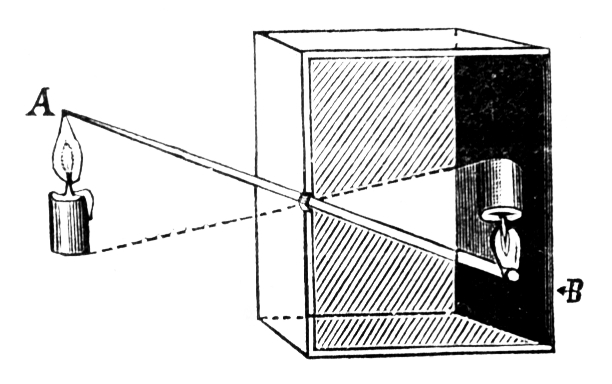 |
In England, a man named William Henry Fox Talbot was creating his own version on Camera Obscura. he experimented by dipping writing paper in silver chloride, which was dried then exposed to sunlight under flat objects such as lace or pens. Not only did William discover that an image could be prevented from darkening too much by placing the paper into a strong liquid salt solution, he also found out that although the picture was negative, he could print it onto another sheet of light sensitive paper, therefore showing correct tone values. These process's were the beginning of making the first film processing dark room.
1839-1850
Photography didn't get the head start it wanted, as everyone was more interested into the less costly business of sketches and paintings. However, Newspaper reporters could see the significance. In 1839, photographers subjects were mainly buildings, or other still life scenes which needed about 15 minutes exposure time, where as portraits were a bigger challange. The slightest move from the subject would ruin the image, so the subects had to stay incredibly still. Occasionly metal plates were used to hold the head together and also to direct the light onto the faces. Eventually, portraiture became more practical when 'petzval lens Voigtlander' from Germany, became available. This improved cameras by creating much brighter images, but pictures were still relatively small. Shops in most large cities then started to begin selling camera equipment, chemicals and silvered cropped plates.
Some of the first daguerreotype style portraiture was to be taken in a glasshouse constructed room at the top of a building. In this room, you had to sit in a upright chair on a raised platform, where a sheet of blue tinted glass would rest above the subject to help reduce the heat of the sun. The background was normally a plain background to make the subject stand out.
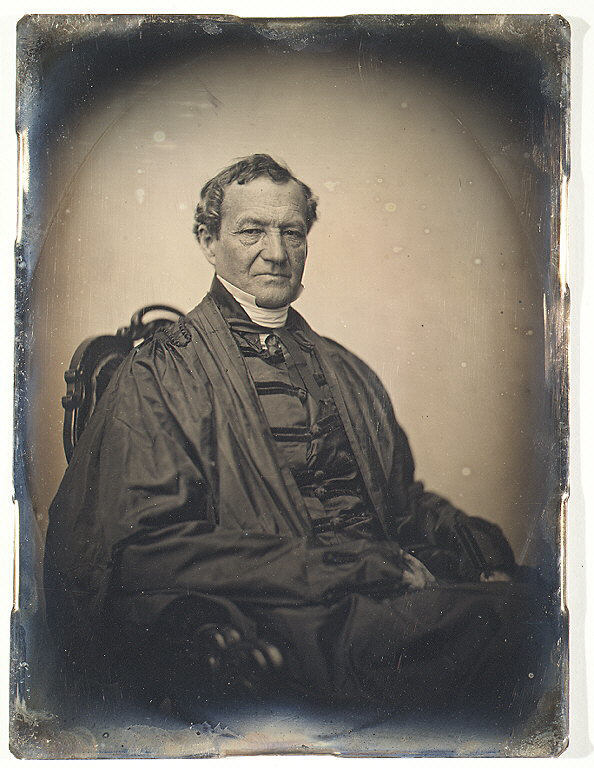 image taken from http://www.metmuseum.org/Collections/search-the-collections/190020182#fullscreen | As exposures were still very long, metal plates were clamped behind your neck to keep the persons head still and the forearms would rest on the arms of the chair. They would be told to stare straight into the camera, blinking and avoiding movement as much as possible and had to stay still for an exposure time of 1 1/2 minutes. This would then make the daguerreotype image, set in a little frame mounted in a velvet lined case. Most of these images were given a final treatment in gold chloride witch darkened the edges of the image making the white subject stand out more clearly. Also, if people wanted a coloured image, it could be hand coloured at an extra charge from around £1, which was really only affordable to people in a high paid profession. Yet people were still eager to get a daguerreotype done for themselves and this soon became a vast fortune business. Besides this style of photography, Talbot was working on his own style which was seen by only a few enthusiasts, called the 'Calotype'. The Calotype process, involved printing an image onto a negative, which was then used with sunlight to be contact printed on another piece of paper to give the final image. The trouble with this process was the loss of fine detail, the slower processing and poor sensitivity to light, hence why no one was really taking a lot of interest. Yet, Talbot set up a calotype piece of work called 'The Pencil of Nature'. It contained 24 large pictures taken by Talbot and the process under each image.This was separated into 6 parts and was sold between 1844 and 1846. This process was then adopted by David Hill and Robert Adamson |
This was separated into 6 parts and was sold between 1844 and 1846. This process was then adopted by David Hill and Robert Adamson who worked to produce hundreds of portraits using this style.
1851-1870
In the 1850’s a new process was created called the ‘wet plate’ or ‘collodion’. Frederick Scott Archer had been trying to improve photography by using glass plates and he soon discovered a sticky liquid named Collodion which formed a good binder. Archer’s process of the ‘wet plate’ went like this:
1. Under a red light pour mixture of collodion and chemical over a sheet of glass and leave to soak for several minutes.
2. Sensitize this and expose the camera while still damp
3. Expose in the camera for about 30sec to 2 minutes at f11.
4. You should then develop, fix and wash the image immediately
One of the main advantages to this new process was that it gave negatives great strength of detail and sharpness. You could also make lots of permanent prints onto albumen paper, which made them attractive to buy and sell as they were quite cheap to buy. Normally 12 paper prints were equivalent to 1 daguerreotype. Although, it did have some negative points. The process wasn’t that easy to use as you had to skilfully flow the thick liquid evenly over the glass sheet, then you had to sensitise, expose and process the image which was fairly difficult for people that didn’t have a darkroom on their doorstep.
Another possible form of collodion negatives was combination printing. This was where an image’s composition would be set up before the shot was taken and in various different negatives, which would be then compressed to make on final image.
The wet plate era grew even more when the stereoscopic photography became available. When using a double camera with lenses being 65mm apart, two images could be exposed side by side onto a collodion plate, giving a more natural view to the left and right eyes. It was when these images were then put together, that they discovered our eyes adjusted to the image creating a three dimensional image, with foreground objects standing out and the background being much more noticeably spaced back. It was from 1855 where stereo pictures of landscapes and portraits could be bought in most shops and this was when the carte-de-viste craze began. Photographic portraits were beginning to be used as visiting and calling cards. Over 3000 celebrity cards were being printed daily and in 1855 there were only 66 portrait studios, yet in 1861 there were over 200 studios. However the carte-de-viste craze soon became to die out, almost as quickly as it was to fly straight into fashion. Many photographers were now making little money on the prints as they were now described as dull and un-fashionable.
The first big Photography exhibition took place in London in 1852. Roger Fenton was one of the first collodion style photographers whose work was shown here, which opened up the worlds eyes to the current state of new art.
1870-1900
Looking further beyond the collodion process, gelatine was now being used instead of collodion as it threw away the need to prepare your own materials before taking a picture and it is the base of photography as we know it today. Richard Leach Maddox described how the gelatine emulsion containing silver bromide could be prepared and warmed, then spread across a thin sheet of glass. It didn’t crystallise like collodion, but swelled good enough for developing and fixing solutions to act easily. He also discovered that the new emulsion became very sensitive to light by pro longed heating.
There were 2 main advantages to the dry plate process:
1. You no longer had to carry a tent with chemicals when working on location. All that was needed was a number of plate holders
2. The gelatine plates were so sensitive to light that they could have an exposure time as little as 1/25 of a second and a tripod were no longer essential.
The most revolutionary new camera for starting off photographers became available from a man named George Eastman. He had heard about the British developers and emulsions and created a plate-coating machine, which then led to his own company in a rented flat in Rochester, Eastman Dry Plate Company. But what he was really known for, was the invention of the first Kodak camera in 1888. He realised that the new materials simplified photography, removing all the technical stages that prevented the normal public from taking photos.
