Starting My Own Business - The Basics
When starting my business, I need to consider the different options available. I need to decide whether my business will be full-time or part-time and where my photo shoots will be taking place. This will depend on my experience, lifestyle, expenses and resources. I will need to assess my own skills and whether I need extra support.
Copyright
"Learning Copyright is a huge part of succeeding with my business. It is crucial that I learn the rules of copyright off the back of my hand to ensure I don't put my business and future into danger.
In it's simplest form, Copyright, also known as the Copyright, Design and Patents Act (CDPA) (1988), is the legal protection and rights of creaters and producers within the UK. Here is a quick example of what can be copyrighted:
- literary - novels, computer programs, newspaper articles, film storylines, character biographys
- dramatic - including dance routines, theatre productions
- music - song lyrics, albulm art work, tracks
- artistic - paintings, photographs, sculptures, architecture, logos and symbols
- others - recordings, broadcasts, website layouts
Sometimes, you can have more than one copyright for one piece of material. For example, an artists albulm can be copyrighted as a whole, yet the artwork and lyrics can both be copyrighted to the creater or publisher.
You can't copyright work which is an idea. To have the legal rights and protection for your piece of work, in whatever medium, the work has to be fixed and put into use, which therefore automatically makes it copyrighted. Most work has this small symbol on it to represent the copyright - ©. Re-producing work that has been Copyrighted can have serious consequences. An example of this can be found on the link below:
http://www.jeremynicholl.com/blog/2012/05/14/how-to-nuke-your-own-business-steal-a-photo/
Sometimes, you can have more than one copyright for one piece of material. For example, an artists albulm can be copyrighted as a whole, yet the artwork and lyrics can both be copyrighted to the creater or publisher. You can't copyright work which is an idea. To have the legal rights and protection for your piece of work, in whatever medium, the work has to be fixed and put into use, which therefore automatically makes it copyrighted. Most work has this small symbol on it to represent the copyright - ©. Re-producing work that has been Copyrighted can have serious consequences." An example of this can be found on the link below: http://www.jeremynicholl.com/blog/2012/05/14/how-to-nuke-your-own-business-steal-a-photo/ |
Sole Trader
"This is the simplest form of company, requiring no registration other than the notification of your local tax office, but it is also the type of business exposed to the greatest personal risk: as a sole trader, you are responsible for all aspects of the company, and have unlimited liability to all debts and legal actions. You may find it more difficult to attract outside investment or partners, which can hinder the expansion of the business. You might also find it more difficult to attract business – you do not have to file accounts or records with Companies House, giving a lack of company transparency, and making it impossible for potential customers to verify your background via an official third party." - http://www.simpleformations.com/types-business.htm#sole
Advantages
- The firms are usually small, and easy to set up.
- Generally, only a small amount of capital needs to be invested, which reduces the initial start-up cost.
- The wage bill will usually be low, because there a few or no employees.
- It is easier to keep overall control, because the owner has a hands-on approach to running the business and can make decisions without consulting anyone else.
Disadvantages
- The sole trader has no one to share the responsibility of running the business with. A good hairdresser, for example, may not be very good at handling the accounts.
- Sole traders often work long hours and find it difficult to take holidays, or time off if they are ill.
- Developing the business is also limited by the amount of capital personally available.
- There is also the risk of unlimited liability, where the sole trader can be forced to sell personal assets to cover any business debts. - http://www.bbc.co.uk/schools/gcsebitesize/business/aims/partnershipsrev1.shtml
Future Proofing
As my business relies on technology, I have to ensure that I always stay up to date with new technology. Future proofing is making sure you always stay ahead of technology, ensuring that the technology and formats you use will always be accessible.
Here is an article from the guardian with tips on proofing an arts organisation. I can refer to this as the medium is very close to mine.
"Think consumer, not just art: The best organisations across the creative economy have and do focus deeply on the lives of their consumers, what else effects them and how they will change over the coming years. This location matters – Nissan opened its design studio in London because it wanted to capture the liveliness of the capital at source through exposing its design team to it first hand."
"Widen your trend watching: Make sure you're looking at a wide variety of trends by drawing on information from a diversity of sources and perspectives. This will include sector trends – be that creative, technical or audiences – but it should also include others. What's happening to your local population, for example, and how are the politics of your local authority shifting?"
Whole article here - http://www.guardian.co.uk/culture-professionals-network/culture-professionals-blog/2012/jan/18/tips-future-proofing-arts-organisation
VAT TAX
"VAT is a tax that's charged on most goods and services the VAT registered businesses provide in the UK. It's also charged on goods and some services that are imported from countries outside the European Union (EU), and brought into the UK from other EU countries. VAT is charged when a VAT-registered business sells to either another business or to a non-business customer. Businesses add VAT to the price they charge when they provide goods and services to:
If you're a VAT-registered business, in most cases you:
|
If you are not VAT-registered then you cannot reclaim the VAT you pay when you purchase goods and services.
When a VAT-registered business buys goods or services they can generally reclaim the VAT they have paid.
There are three rates of VAT, depending on the goods or services the business provides. The rates are:
- standard - 20 per cent
- reduced - 5 per cent
- zero - 0 per cent
- accounting period: see tax period
- acquisitions: goods brought into the UK from other EU countries - (goods brought into the UK from outside of the EU are known as Imports)
- corporate body: an incorporated body such as a limited company, limited liability partnership, friendly, industrial or provident society
- distance sales: where a business in one EU country sells and ships goods directly to consumers in another EU country, eg internet or mail-order sales
- exports: goods sent to a non-EU country
- despatches: goods sent to another EU country
- imports: goods brought into the EU from another country
- input tax: the VAT you pay on your purchases
- output tax: the VAT you charge on your sales
- place of supply: the country in which a supply of goods or services must be accounted for VAT purposes
- self-billing: your customer issues your VAT invoice and sends a copy to you with their payment
- supply: selling or otherwise providing goods or services, including barter and some free provision
- supply of goods: when exclusive ownership of goods passes from one person to another
- taxable person: any business entity that buys or sells goods or services and is required to be registered for VAT - this includes individuals, partnerships, companies, clubs, associations and charities
- taxable supplies: all goods and services sold or otherwise supplied by a taxable person which are liable to VAT at the standard, reduced or zero rate
- taxable turnover: the total value - excluding VAT - of the taxable supplies you make in the UK (excludes capital items like buildings, equipment, vehicles or exempt supplies)
- tax period: the period of time covered by your VAT return, usually quarterly
- tax point: the date when VAT has to be accounted for - for goods, this is usually when you send the goods to a customer or when they take them away, for services, this is usually when the service is performed
- time of supply: see tax point" - http://www.businesslink.gov.uk/bdotg/action/detail?itemId=1081174917&r.i=1081174900&r.l1=1073858808&r.l2=1083126673&r.l3=1081167361&r.s=sc&r.t=RESOURCES&type=RESOURCES
National Insurance
"Broadly speaking, National Insurance contributions (NICs) are payable on employee earnings, including non work related expenses and provided benefits. There are different classes of NICs that apply in different circumstances. Some are paid by both employers and employees, some by employers only and others by the self-employed. As an employer your main responsibilities are: If any of the people you engage to carry out work for you are self-employed, then they're responsible for paying their own NICs (Class 2 and Class 4)." - http://www.businesslink.gov.uk/bdotg/action/detail?itemId=1084473629&r.i=1084472892&r.l1=1073858808&r.l2=1073859218&r.l3=1084472530&r.s=sc&r.t=RESOURCES&type=RESOURCES
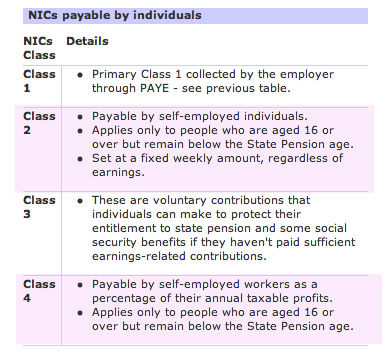 | The sections highlighted in pink are the class's that I will be taxed upon. |
Self Assessment and Tax Returns
"Self Assessment involves completing a tax return each year. You show your income and capital gains (profits on the sale of certain assets) and claim tax allowances or reliefs on your tax return.
You need to register for Self Assessment before you can get a tax return. HM Revenue & Customs (HMRC) will use the information you provide to set up the right records for you. They will then send you a ten-digit tax reference, called a Unique Taxpayer Reference. You will need to keep this safe. HMRC will send you a letter each year, usually in April telling you to complete your tax return. If you haven't received this letter or a tax return by the end of April, you should get in touch with HMRC. You can send your tax return online or on paper. There are lots of benefits to sending it online. It's quick, easy and you have three months longer to send it. Tax Return Deadlines If you send in a paper tax return, it must reach HM Revenue & Customs (HMRC) by midnight on 31 October. If you miss this deadline you should send your return online. If you send in your tax return online it must reach HMRC by midnight on 31 January. You'll have to pay a £100 penalty if HMRC doesn't receive your tax return on time. The later you send your return, the more penalties you're likely to pay." - http://www.businesslink.gov.uk/bdotg/action/detail?itemId=1081526103&r.i=1081525898&r.l1=1073858808&r.l2=1073859209&r.l3=1082611551&r.l4=1081526062&r.s=sc&r.t=RESOURCES&type=RESOURCESHow to get a Self Assessment tax return
